Tuesday, November 29, 2011

Sausage-lust in the Mountains (6 of 7 on the AT)

I’ve had the good fortune, three or four times, of spending an entire week backpacking in the mountains. That’s one of the chief advantages of spending many, many years as a college student – there’s always a break on the horizon. In my pre-children years, I’d often spend those college breaks backpacking.

One thing became very obvious to me on those trips. Spending seven continuous days hiking and camping is a very, very different experience than hiking and camping for seven days spread out over the course of several months. Knowing that you’ll step into the woods on Saturday and step back out of them the following Saturday changes everything – the physical exertion, the packing, the planning. It also gives you a different outlook. There’s a sense of immersion in the wilderness that you just can’t get by being out for just a night or two.

The first time I spent an entire week in the woods, I hiked the 70 miles of the AT in the Smokies. It was on about the fifth day that I had my sugar and meat conniption. I had planned my food so that I ate the same thing every day. Breakfast was granola bars and chocolate (powdered) milk, lunch – the meal you eat all day long between breakfast and supper – consisted of cheese crackers, raisins, and peanuts. For supper I’d have a couple of packets of dried chicken noodle stew – just add boiling water. I had intentionally omitted candy. Same routine every day. That was a mistake.

By the fifth day I was obsessing about… well, the list would be long. Let’s just say I was obsessing about everything except granola bars, powdered milk, cheese crackers, raisins, peanuts, and dried chicken stew. I really wanted some chocolate candy and a Coke. But when we stopped for a break at Pecks Corner shelter, what I really, really wanted was the big sausage log that another hiker was eating. Murder was out of the question. Too many witnesses. Robbery was an option, but I’d never actually robbed anyone before, so I wasn’t real confident that I could pull it off. Sleight of hand might work, but he wouldn’t lay it down. He protected that sausage log like a mama bear protects her cub. I think he could see the sausage-lust in my eyes.

During the conversation in the shelter we discovered that he and his partner had just started at our destination, Davenport Gap, the day before. They were spending a week on the AT, going the opposite direction from us. That meant offering to trade food with him was out of the question. First of all, all I had was junk. Powdered milk, cheap cheese crackers, raisins. If he had traded a couple of slices of his meat stick for some of my food, it would have been a clear case of babysitting on his part. I just couldn’t lower myself to ask. I’d been self-sufficient all week. I didn’t want to give in now and have other people start taking care of me. Second of all, he was just starting on his trip. You just can’t try to get a guy to give up some of his prized food possessions that early on the trip. So, I just sat there and burned with desire for some smoked sausage. I know man doesn’t live by bread alone, but right then a bite of sausage would have been nice.

In my defense, I thought about trading for the meat before I considered murder and robbery. A week in the woods hadn’t destroyed all my scruples, but they were in a weakened state regarding meat products.

Our arrival at Tricorner Knob that evening prompted our usual routine. Claim a bunk, some prefer top, others prefer bottom. Find the spring and get water, usually 50 or 100 yards down one side or the other; a well-worn trail showing the way. Read or take a quick nap before supper. Some guys carry a pair of tennis shoes to put on now. I didn’t because of the extra weight, but I seriously consider it every time I backpack. If this trip had been shorter, I might have included them, but an extra couple of pounds was a lot to carry for a week. Now that we were at the evening’s shelter, I burned with desire for my partners’ tennis shoes. Apparently, this was just a good day for coveting my neighbor’s stuff. Again, in my defense, I’m pretty sure that was the only one of the 10 commandments I broke that day. For me, that’s a pretty good day – which is another reason for wives to encourage their husbands go backpacking – it’s almost impossible to get in trouble with the police or God when you spend all your time walking, eating, and sleeping. You’re just too tired and preoccupied to get into any mischief. [To be continued]

Monday, November 14, 2011

The Unabomber (5 of 7 on the AT)

When you spend a few nights on the Appalachian Trail in the Smokies you’ll meet some interesting people. Sometimes “interesting” is good, sometimes not. (Like that old curse: “May you live in interesting times.”) About half the time, you’ll have one hiker in the shelter who is just plain strange. I don’t know why, but these guys almost always arrive late, after dark like possums or vampires. There are two types: the guys who don’t speak at all to anyone and the guys who are eager to share their vast reservoir of experience with the rest of us, even if our body language is making it absolutely clear that we aren’t interested in hearing it.


The quiet guys make you wonder what they are up to, but at least they aren’t annoying. The talkative guys, however, can really get on your nerves. A talkative one showed up at the Spence Field shelter about an hour after sunset.

 “Is this Russell Field? I lost my maps a week ago.”

 “No, this is Spe…”

 “It doesn’t matter. I’ve been out for 6 months. I’ve been in Colorado and Virginia and started at Big Creek two weeks ago. They let us through-hikers sleep wherever we want.”

 “Actually, this shelter is full. You’re supposed to make reservations.”

 “Not me. Just sleep where I want. I’ll just sleep here on the floor. You guys’ll have to put your packs somewhere else” (A pause to take a breath and change subjects, which he does periodically.) “You know, breathable jackets don’t really breathe. It’s physically impossible for the water vapor to escape.”

 At this point, no one is listening, and everyone has his back to the intruder. We are busy putting on our breathable jackets, which we wouldn’t hike without. We all swear by them.

 “I’m telling you, it’s the biggest sham ever perpetrated by the backpacking apparel industry.”

 “Okay,” I’m thinking, “I’m always willing to concede the point that public opinion is manipulated by Madison Avenue, not to mention the CIA, the Pentagon, and the New York Times, but if this guy mentions aliens…”

 “I think it’s alien technology that has a more sinister purpose. I’m presently doing research for my dissertation. I’m not in a grad program right now. Stinkin’ experts don’t respect the truth, but I’m on the verge of a breakthrough. You’ll read about it when I publish my results.”

 I’m thinking how sorry I am that I let my subscription to Mad Magazine lapse; looks like I’ll miss his exposé on breathable jackets. Everyone else is thinking, “Don’t make eye contact. Don’t speak. It will only encourage him.”

 Everyone, that is, except one of the college guys who’s a bit too daring. “I know what you mean, man. When I was a kid I was abducted by them little, gray b-#@&-s.”

 “Then you know of what I speak. They are up to something. That’s why I spend my time away from everyone and everything. The X-Files are real, man. Not the werewolves and vampires. The alien agenda.”

 I’m thinking, “I don’t know exactly what the ‘alien agenda’ is, but I hope it involves taking this guy with them. Soon.” It was at this point that I began thinking we normal ones should draw straws to determine who will stay awake all night standing guard. We never actually posted a sentry that night, but we all tried to stay awake until we were sure the guy had gone to sleep.

 He was gone when we awoke in the morning. Someone asked, “Where’s the Unabomber?” and we all got the joke.  

 “I saw a bright flash of light from the sky last night, and never saw him again. He’s probably on Neptune by now.”

 One of the college guys made the closing remark as he shouldered his pack and walked out the front gate: “He must be glad to be home.”

Wednesday, October 26, 2011

KIndred Spirits (4 of 7 on the AT)


The Smokies are such a revered location among hikers that you see quite a few people on the 72 miles of the Appalachian Trail that runs along the main crest of the Smoky Mountains. You won’t normally feel crowded, but you definitely are not isolated. This catches novices by surprise because they expect a wild, empty wilderness, but what they get on most of the 2,170 miles of the AT is a variety – some wilderness, some small towns, a few farms, and even an interstate highway or two. You see plenty of people, both hikers and trail-side residents. I don’t know what the longest stretch of AT between paved roads is, but I suspect that the 41 miles from Fontana to Newfound Gap and the 31 miles from Newfound Gap to Davenport Gap are both in the top ten.
Two Kindred Spirits

Most of the people you encounter on the AT are normal, well-adjusted folks, but there are a few screwballs and eccentrics.  

Many years ago I spent a week in the Smokies hiking the 72 miles of the AT. My hiking partner and I spent a couple of nights in shelters with a guy from England, who had quit his job and was taking a couple of years to wander around “the New World,” as he called it. He’d recently traversed South America and the Pacific Crest Trail in California and was now hiking the AT, although probably not the entire AT because this was late August and he was still in the Smokies, heading north. If his goal was Mt. Katahdin at the north end of the trail, he was about 4 months behind schedule and would arrive in Maine in December. Yeah, I’m guessing he got about as far as New Jersey and then went to visit the Statue of Liberty before heading back to London. We envied him.

Then there were the two carpenters from Florida. They’d work about 4 months a year, November through February, building houses. The other 8 months were spent camping and backpacking, sometimes in the eastern US, sometimes out west. Eight months of free housing in shelters and campsites, seeing the prettiest parts of the US. No health insurance, no families, no retirement plan, no permanent address. They were being very irresponsible, and we envied them for it, wishing that we had the guts to be so free.

When you are out on the AT, you’ll frequently run into young couples, maybe married, maybe not. Although you might think there would be some interesting stories that would emerge from this, there usually aren’t. Generally, these young couples keep to themselves and don’t have much to say to the rest of us. Although, occasionally you’d hear some giggles from their corner of the shelter late at night. Young couples always sleep in the corner, away from the riff-raff.
An old man and his wife

The most entertaining are the groups of college-age guys who know each other well and are hiking together. They laugh and joke until late into the night. Occasionally their light-heartedness is enhanced by mind-altering substances, which often jump starts a song or two. Every now and then one of them will pull out an obscure musical instrument, a harmonica being the most common, although occasionally it would be a ukulele or wooden flute. If you’ve never heard Stairway To Heaven accompanied by a ukulele, then … well, actually you haven’t missed much. When it’s happening you feel like you’ve stumbled into Monty Python’s Flying Circus, but usually with stout southern accents.

It’s not exactly a wilderness experience, but even an anti-social type like me can’t help but love the sense of camaraderie that develops among those kindred spirits you meet on the AT. In those moments, there’s a sense of fellowship that most churches would envy.

On the other hand, there’s also the occasional oddball who appears to have graduated from the Ted Kaczynski School of Charm… [To be continued.]


Monday, October 10, 2011

Don't Feed the Bears (Third of 7 on the AT)

In recent years the National Park Service has changed their policy toward the rock and log shelters on the Appalachian Trail in the Smoky Mountains. There are now steel poles and cables outside of every shelter. You hang your food bags on these cables so the bears, raccoons, skunks, and mice can’t get them. These cables don’t seem mouse-proof to me, but apparently the mice haven’t figured out what’s going on because they don’t seem to get into the food bags hung high on these outside cables. Maybe they are afraid of heights. Climbing these poles and cables would be like climbing a tree. These are, after all, field mice, not tree mice, right? I have no idea why squirrels haven’t cracked the code. For whatever reasons, the cables do their job most of the time.

The main problem now is rain on your food, so you must use a waterproof bag for your food – or just cover your bag with your rain jacket. Even so, I always hope it rains at night because one of the greatest sounds in the world is rain on a tin roof, which all these rock shelters have. A rainy night in a tin-roofed shelter on the crest of the Smokies is a simple, delightful experience. Just one more compelling bit of evidence that Thoreau was right when he wrote, “That man is richest whose pleasures are the cheapest.”

The NPS’s rationale for removing the fences across the front of the shelters was to enhance the wilderness experience, and in my opinion, it has. But even more importantly, it is a refreshing step back into the past. If you think about the overall trend of our society toward litigation, disclaimers, and bureaucratic rule-proliferation, this move by the NPS is an astounding, unprecedented step backwards, in the right direction. It’s the only example I can recall of a major government or corporate institution bucking the trend of more stupid rules to protect us from ourselves. You’ve heard all the stories – lawsuits over hot coffee and slippery floors. Don’t swim here. Don’t run there. No trespassing. Let me add one more example. While eating out of a can of almonds recently, I looked on the back of the can, and I noticed an allergy warning. It said, and I quote, “Warning: Contains almonds.” Yeah, thanks for exposing that hidden threat. I guess the corporations and lawyers think we’re a nation of idiots – or greedy pigs who will sue an almond company for putting almonds in a can of almonds without a warning. A few of us probably are, so the rest of us have to put up with being treated like morons. Welcome to modern life.

Take a moment and try to think of any change in the last 30 years that knowingly increases risk. Imagine… opening up a shelter, risking the possibility that a bear might enter! Whoever had this idea should be identified, named publicly, and have her face carved onto Mount Rushmore. She would get my vote for president. I hope she’s still working for the National Park Service, but I’m afraid she probably has trouble keeping a job because she just doesn’t fit in with the prevailing government or corporate culture. Maybe the NPS is the last bastion of sanity in Washington, but that’s not something we can expect to last forever.

So if you are worried about bears, take a couple of rocks or a stout walking stick to bed with you because now there’s no fence to protect you. You can throw the rocks at any bears that show up, or just bop him on the nose with your stick. He’ll get the point. And don’t put any food in your sleeping bag. I’d hate to get to one of these shelters and see signs all over it, stating and restating the obvious: “Warning: Bears are attracted to food.” Of course, anyone who hasn’t figured that out by now will probably be removed from the gene pool by a hungry bear anyway, so the problem will correct itself through natural selection.


Thursday, September 22, 2011

Night Moves (2 of 7 on the AT)

Many years ago, I spent a week with three friends hiking the 70 miles of the Appalachian Trail in the Smoky Mountains. The four of us spent our fifth night in our old friend, Icewater Spring shelter. I’ve spent more nights in the Smokies in this shelter than anywhere else in the park. It’s also the park’s most heavily-used shelter because it’s only a three mile hike from Newfound Gap, and it can serve as a gateway to a nice hike up Mt. LeConte or to Charlies Bunion.

We slept well that night. Eventually…

When Allen started screaming, my response was to hunker down deeper in my sleeping bag, hoping that whatever was killing him would not notice me. After a few seconds I heard Joey talking to him, calming him down. At that point, I realized, through the fog of sleep, that we were not being killed and eaten by a bear. It was one of Allen’s nighttime episodes. I had heard that he sometimes would wake up at night screaming, but I hadn’t experienced it until that night at Icewater Spring. Allen had been my most consistent backpacking partner during that period in my life, but it was times like this that I wondered if maybe we should have put each other through an application process. Question 1: Have you ever backpacked before? (Because you don’t want to have to babysit your backpacking partner.) Question 2: How fast can you run? (Because you don’t have to outrun a bear; you only have to outrun your hiking partner.) Question 3: Do you ever wake up screaming in the middle of the night? (Because I don’t like a wet sleeping bag.)

Nevertheless, we made it through the night just fine. Until the mice started their nightly escapades.

These old shelters are rustic, solid, and secure. Well, they were secure several years ago. Today there’s no front on them, but for many years there was a chain link fence and gate across the front to keep out the bears, which was important because we hikers would hang our food in bags from the rafters. The mice loved it.

There were two approaches to dealing with the mice: deterrence and acquiescence. The deterrence approach entailed using a plastic or metal lid with a small hole punched in the middle. You would slide the lid onto the rope holding your food bag from the rafters. Except for the case of unusually acrobatic mice, the critters couldn’t get all the way down the rope to the food bag. This approach usually worked, but when it didn’t, you’d end up with holes chewed in your food bag and in your packets of gorp, milk powder, noodles, and cheese. Acquiescence meant forgoing the lid and just leaving your food bag exposed and open. It was sort of like going through customs in a third world country. You’d leave a little “gift” in your luggage for the inspector, and he’d let you in. The mice in the shelters operated in the same fashion. You cooperate, the mice get their small share, and everyone parts as friends in the morning.

I finally settled on a combination of the two approaches. I’d use the lid on the rope, but I’d keep my food bag open. If the mouse made it past the lid, he’d have easy access to my food bag, and I’d end up with a corner of my gorp bag chewed but no holes in my backpack or food bag. Not a high price to pay, as long as the mouse didn’t get mad about the lid on the rope and exact his revenge while I slept.

Sometime during the night the skunks made their entrance. They’d usually just wander around looking for food scraps, and when they were finished, they’d leave by whatever hole they had entered. Only once did I have to get up out of bed and let a skunk out the front gate. He needed help getting out and seemed genuinely appreciative for the favor. He didn’t spray me.

That night at Icewater Spring, behind the chain link fence, we were visited by mice and skunks, but no bears. But it did rain, which was perfect percussion music for sleeping. Which we finally did, when all the screaming stopped.
 

Thursday, September 1, 2011

Those Dark, Dirty Shelters (1 of 7 on the AT)


Let’s spend a few weeks talking about the Appalachian Trail, one of America’s best ideas. The AT stretches about 2,170 miles from Springer Mountain in north Georgia to Mount Katahdin in central Maine. You can hike on it for free. For almost its entire length you can hike and camp without any special permits or paperwork – a remarkable accomplishment considering it’s officially owned by the mother of all bureaucracies, the US government. You don’t have to report in to anyone in a uniform or a dark suit and tie. It’s the epitome of life, liberty, and the pursuit of happiness.

Except for the 72 miles of the AT in the Smoky Mountains.

The Smokies are such a revered location among AT hikers that they could easily be loved to death. It’s a Tragedy of the Commons waiting to happen. So, the government has stepped in to stem the tide of mountain lovers.  

Fortunately, the park is administered by what may be the last, sane department of the US government – the National Park Service. I’ve had numerous encounters with park rangers, volunteers, and other staff persons, and 95% of these moments have been pleasant. The good guys haven’t been chased away yet by whatever it is in bureaucracies that squeezes the spark of life out of its employees.  (Now that I’ve said that, I must admit that the folks at our local post office are great, too. One more reason to live in a small town.)

I should also add that there’s a significant group of folks in the Bryson City area who would disagree with my assessment of the NPS – they are mad about Fontana Lake, the Road to Nowhere, restrictions on bear hunting and ginseng digging, and just about anything the NPS does. Some of them are reasonable people and some aren’t. But I digress…

Even the NPS hasn’t been able to avoid that essential part of every bureaucracy – paperwork. To day hike in the park, just find a trail and go. No paperwork, no permission slips. However, if you want to camp overnight in the backcountry, you’ll have to fill out a permit. (No fees yet, but they are talking about it.) When you arrive at the park, you must find a ranger station and spend five minutes filling out an itinerary. That’s it. Five minutes. Stop for a moment and let that sink in. A five minute encounter with the Federal government. To get the full impact of that, stop for a moment and think about what you were doing on April 14.

If you camp on the AT in the park, you’ll be staying in a rock and log shelter with a tin roof. These shelters are heavily used, and they do show some wear and tear, but even the wear and tear is a reminder that you are doing something that people have been doing for several generations. And people will continue to do it long after you are gone. You are a link in a long chain of main crest hikers. It’s enough to tempt you to carve your name on the old log rafters. (Please don’t.)

Several years ago, a guy named Bill Bryson wrote a book called A Walk in the Woods. He and a friend, both novice backpackers, decided to hike the entire AT from south to north. To make a long story short, they limped and whined all the way to the Smoky Mountains. Once there, they didn’t like the “dark and dirty” shelters, so they quit hiking at Newfound Gap, caught a ride to Gatlinburg, ate some cheeseburgers, then drove to Roanoke, VA. They skipped the eastern half of the Smokies, all of Tennessee, and much of Virginia! I was so disgusted that I quit reading. I don’t know and don’t care how the book ends, but I hope at some point they came to grips with the reality that if you hike the AT, you are going to get wet and dirty, and the accommodations are somewhat primitive. That is, after all, the point.

So call these shelters dirty and dingy if you want to. I call them rustic and quaint. Not in an antique shop way. More of an old barn way. They are drafty, uncomfortable, and crude. They have mice and skunks, and an occasional bear. In other words, they are great, perfect – exactly what you’d hope for on a backpacking trip in the mountains.

Tuesday, July 26, 2011

Incompetence Rears its Ugly Head (Again)

In a previous article I pointed out that someone – such as myself – could be “avid” without being competent. I offered a bit of proof, but in case you still are not convinced, I present further evidence.

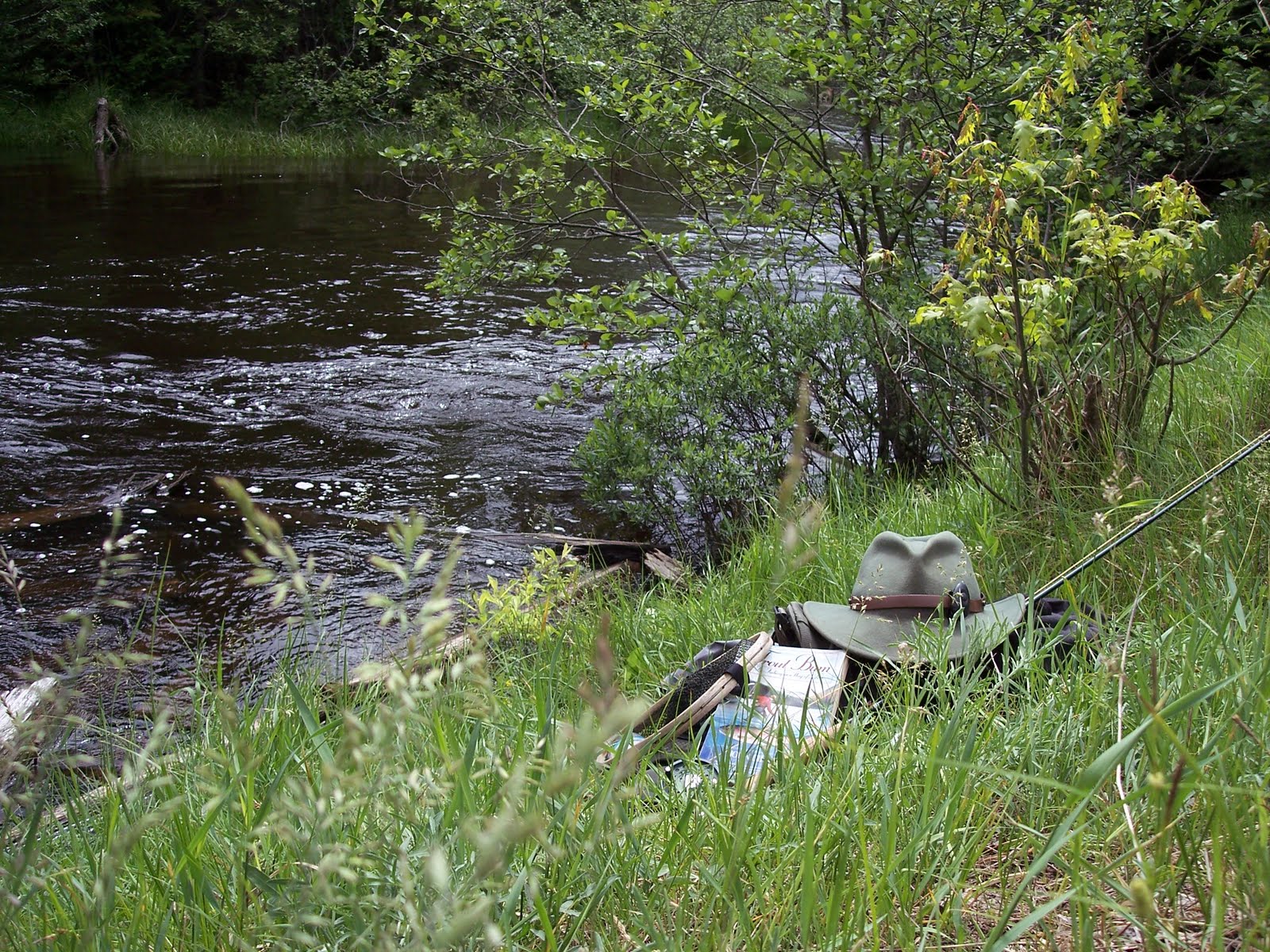
Keith Oakes and I were night fishing on a river full of big, brown trout, creatures that are notoriously nocturnal. We heard a couple of splashes in the river in front of us, which might have been mice, muskrats, or beavers, or it might have been a trout feeding on a mayfly, so we immediately began casting toward the sounds. Casting a fly is very different from casting a lure with spinning gear. When you cast with a fly rod you typically keep the fly line and fly in the air for several casts as you let out more line, then after 3 or 4 of these “false casts” you let the line go as the fly whips and then floats down to the water’s surface. It’s during these false casts that you are likely to get your fly and line caught in bushes or branches behind you. That’s not at all unusual on wooded rivers.

AuSable River: Waiting for the sun to set

Midnight on the AuSable River, Grayling, Michigan


On one of my false casts I felt my line get caught on something, and I knew I had managed to get hung up on the willow bushes behind me. Then I decided that it must be the end of a long limb because as I tugged gently on the line it wasn’t just stuck, it was jumping around, pulling back. But even that didn’t seem quite right. There was a random sort of tugging to it, sort of a big, wobbling pull. Just as the awkwardness of it was starting to register in my brain, my line took off in a circle around me. Once, twice. I had caught a bat, and it was flying in one direction, which meant that it was wrapping itself around me, which of course meant that it was getting closer to me, like a game of tether ball where the rope wraps around the pole until there’s no loose rope left to wrap.

Well, that’s exactly what the bat did, until it ended up somewhere on my back, squealing and thrashing. Now, I say it was “somewhere on my back,” meaning that it was actually on my back, tangled up in my fishing net which was hanging from my fishing vest, but I didn’t know that at the time because it was dark, and I couldn’t see a thing. He might have been on my hat, or under my arm, or on my chest, etc. etc. And of course, all I could think about was sharp teeth, rabies, and Dracula. The fact that it was dark merely added another level of anxiety and confusion. So I tried to get my vest off, but I had to reach around to the clips on the side to get it off, and for all I knew that’s where the bat was. The squealing and thrashing continued, while I wiggled out of the vest and unwrapped the line from around me. When I finally got the vest off and threw it on the river bank, the bat was gone.


I heard a small splash nearby, so I shined my flashlight downstream and saw the bat on the surface of the water, still kicking, but floating downstream with the current. The Bat Incident was over, and I had survived. The bat, apparently, would not. But let the record show that I had him in my net for a few seconds. I’m sure a few other fly fishermen have hooked a bat, although probably not a lot, since not a lot of guys fly fish at night. But how many of them can say they got the bat to their net and then safely released him as all genteel fly fishermen do? And if he died somewhere downstream, it’s not my fault bats can’t swim.

Keith finally made his way over to me about the time the bat was disappearing downstream. “What’s going on down here? It sounded like a wrestling match. I thought you caught a huge fish, but then everything went silent.”

“Not a fish. A bat.”

“Really? A bat? So that explains all the squealing and crying.”

“Yeah,” I said, “and I think the bat was scared, too.”

So, confine your fishing to fish if you want to. Not me. I’m expanding my quarry. I’m fishing for mammals. Winged mammals. Catch and release only. It’s a sport only a truly avid outdoorsman could appreciate.

Every now and then I catch a fish instead of a bat