Tuesday, December 4, 2012

A Tale of Two Seasons (1 of 5)


It was the best of times, it was the worst of times. It was hot, it was cold, it was rainy, it way snowy, it was sunny, it was stormy. It was March.

Here in East Tennessee the month of March is the time when we dare to get our hopes up. It’s the month when the seagulls leave Cherokee Lake. It’s the month when the Daffodils typically bloom (although, Daffodils are a gullible breed who can be tricked into blooming just about any time after the New Year). The Serviceberry tree at the end of my driveway blooms a brilliant, delicate white. Many of us get our first, glorious sunburn in March, usually from doing yard work in a T shirt.

It’s also the month that we get the most snow, tornados reappear after their winter hibernation, and we get back to pulling weeds and cutting grass. March is the month when I try to sleep with our windows open about six inches so I can hear owls and mockingbirds at night and wrens in the morning, but then must get up in the middle of the night to close them because the heater has kicked on. I’m willing to endure numerous hardships to enjoy the great outdoors, but burning propane unnecessarily isn’t one of them. Yes, March is the time when we dare to get our hopes up, only to have them crushed by the tilt of the earth in relation to the sun, only to have them raised again the next day.

March is a fickle month, but not completely unpredictable. If it’s cold today, it will be warm in a couple of days. If it’s warm today, it will be cold soon. In that respect, March is as predictable as a pendulum. It’s two seasons shuffled into a single month.

March, acting like February

I’ve heard some folks say that they couldn’t live in New England or the Rockies because of January. There’s just too much snow and cold and ice in the middle of the winter. Their winters are too dang deep. Not me. As much as I love the coast of Maine and the mountains of Colorado, I couldn’t live there because of March. In those places, winter is just too dang long. In Tennessee, March is the month in which it becomes obvious that winter won’t last forever.

March, acting like April


Having lived a winter-deprived childhood in Florida, I don’t mind a deep winter with respectable amounts of snow and ice. I like walking around in my home with fuzzy slippers and a mug of hot chocolate. (Winter is the only time of year I wish I liked coffee.) I like watching the Robins form winter flocks as if they intended to migrate south, but then never quite getting around to leaving. Juncos and White-throated Sparrows make their brief, winter appearance under our bird feeder. I don’t even mind scraping the windshield in the morning.

But by March, it’s time to move on. I’m ready to keep the windows open all night. I’m ready to put my slippers away for another year. I’m sick and tired of scraping my windshield. In other words, I love winter… but only for a couple of months. By the middle of March, I’m over it, and thankfully, East Tennessee is pretty much over it, too. Yes, we’ll still get some ice, and maybe some snow, but by late March the back of my neck is peeling from too much sun, and it has become obvious that spring has returned to East Tennessee. In the Rockies, people are beginning to think that their memories of spring are merely hazy remnants of a previous life.

Of course, in March all those hardy souls in Maine and Colorado still have their snow tires and chains on, are still burning wood in the fireplace, and are walking around in fuzzy slippers and robes, trying not to descend into a screaming case of March Madness. As March grinds along, that beautiful blanket of snow starts feeling like quicksand, and a lot of folks probably trade their hot coffee for hard liquor because desperate times require desperate measures.

In one of Robert Frost’s poems, he scolds April for sometimes acting like March instead of May. If he had lived in the South instead of New England he would have shifted his time frame a month earlier. He’d have scolded March for sometimes acting like February. In New England they look forward to April; here, we look forward to March.

Ahh, March! It’s the best reason to live in the South. [To be continued.]


Wednesday, October 31, 2012

Durant's Ghost (Part 3 of 3)


It was pitch black and the voice of an old man – who was completely invisible except the orange glow of his cigar – had instructed me to the only rising fish that I had heard all night. I waded within 10 feet of the fish which is possible at night, but not considered proper technique by some, including the old man.
 

To make a short story longer, the fish rose, I waited about 15 seconds, then I dropped my fly just upstream of the sound and let it drift down. A few seconds later I heard a small splash about where my fly probably was. I set the hook gently. The fight was not an epic battle. It was more like a brief test of wills. He made a few short runs and broke the surface a few times, but he mostly sat and sulked, too proud to surrender. Typical for a good-sized brown trout. After a minute or two he relented, and I scooped him into my net. A deeply-colored, sixteen inch, wild brown trout. Not a huge fish, but large enough that he should have known better.
 

I turned toward the dock to tell my elderly guide that the fish was a flawless sixteen inches, but he was gone. No cigar glow, no congratulations, no “how big is he?” Nothing. Silence. He seemed to have simply vanished into the darkness.
 

What kind of fisherman would leave without seeing how the encounter turned out? Would the Southern guy catch the fish? If so, how big was it? Maybe he knew how big the fish was because he had caught and released it many times over the past few years. Maybe he was disgusted that I wasn’t fishing as a gentleman should and left because he couldn’t bear to listen. Maybe he had to be somewhere before sunrise.
 

I waded across the river and onto the dock and shouted for him: “Woo, thanks! Sixteen inches!” No answer. Just the sound of water flowing against sand, grass, and fallen trees. No sound of footsteps on the path, no car driving away down the dirt road. I walked a little farther to the grassy meadow where Durant’s Castle used to stand and shouted again. Nothing… except darkness, a billion stars, and the sound of a cool breeze rustling the tops of the pines.
 

The old dock from which the glow and the voice had emanated is the riverside access for the old house – Durant’s Castle, a French chateau with fifty-six rooms and seven fireplaces – where Mr. W. C. Durant, the chairman of General Motors, had lived briefly in 1930.  In February, 1931 the mansion burned down, and although he continued to come to the AuSable to fish, Durant never rebuilt, and his riverside property eventually passed into the hands of the State of Michigan which now maintains it as a fly fishing only, primitive area.
 

The AuSable River is the center point of this local community. It is loved and tended and respected. The fact that the fishermen and canoeists who are drawn to it provide jobs and income to this rural area probably helps, but there’s clearly more to the community-river relationship than just dollars and cents. The local folks love this river the way you’d love your mother, not your bank account.
 

One sad-but-true fact about many other rivers – including many of our East Tennessee rivers – is that they are used but not loved. The amount of trash, old tires, junked cars, plastic WalMart bags, beer cans, and bags of garbage on our local rivers is just plain embarrassing to those of us who care about such things. While those rivers are places where people dump their trash, the AuSable is a river where people dump their ashes… of loved ones. While fishing the AuSable we’ll occasionally encounter a guy sitting reverently on the riverbank, paying his respects to the final resting place of his father, whose ashes had been scattered on the waters of his beloved river.  This happens more often than you’d think.

A few miles from Durant’s Castle there’s a stretch of the AuSable called “the Holy Water.” While people don’t come here to bathe and be miraculously healed, this name does show the depth of respect the locals hold for this river. If a community can have a soul, this river is it.

I don’t think much about ghosts, and I’m not sure I believe in them. However, I do believe in the supernatural which does open up a world of possibilities, one of which might be an occasional visit by the ghost of a man who once lived by this river and fished its waters. Rather than being punishment for a profligate life, spending a few years as a disembodied spirit wandering the banks of the AuSable might actually be a reward for good behavior. It’s certainly closer to Heaven than Hell.

The river by the site of Durant’s Castle is a pleasant spot, and if I were a ghost, I’d spend some time there, too. And if the mood struck, I might even point out a rising fish to a passing fisherman so he’d have a story to tell his buddies when they all reunited at the old wooden dock after a night on my river.

Tuesday, October 16, 2012

The Old Man and His Fish (Part 2 of 3)


 After spending several fruitless hours standing in the dark on Michigan’s AuSable River, waiting for mayflies and fish to arrive, I waded downstream toward the old, wooden dock where I could see the orange glow of a lit cigar. Not wanting to disturb a fisherman who was stalking a fish, I called out to him, and an old man’s voice responded slowly and clearly from out of the darkness: “I’m not fishing, but there’s a good fish rising on the other side. I can’t get a good cast to him from here, so you’re welcome to give it a try.” The current wasn’t heavy, but if the river here was over four or five feet deep then he’d have to wade up or downstream to a shallower spot to wade across.  Apparently the old man couldn’t or wouldn’t wade across the river to get to the rising fish.

A typical stretch of the AuSable
 “Are you sure?” I responded. He of course understood that I wasn’t asking if he was sure there was a fish rising. I was asking if he was sure that he was willing to give it to me.

“Sure. I live here and fish this water all the time. I’m done for the night.”

That was all the explanation I needed. “Thanks. I’ll see what I can do.” I stopped and listened for a few seconds until I heard the splashy rise of a fish about 20 yards in front of me. It was exactly where it should have been: directly across from the orange glow and the voice in the darkness, and on the opposite side of the river.

So, I waded silently downstream at about the same speed as the current. Wading upstream against the current would have been noisy, but wading with the current is like walking on air. You step and glide, step and glide, all in slow motion. Under the water’s surface, it probably looks like astronauts walking on the moon.

As I approached the rising fish I moved a few feet further out into the river because the fish would be facing upstream toward me. An unusual feature of night fishing is that you can wade to within 8 or 10 feet of a rising fish as long as you don’t make any sudden, splashy moves. The stars on a clear, moonless night create just enough light for an upward-looking fish to see a fisherman’s dark silhouette against the night sky. So a stealthy approach is still important, but the darkness reduces the distances dramatically. In daylight a fisherman would need to be 20 or 30 feet away from the fish; at night, 8 or 10 feet will do. I also turned sideways in the water to create a smaller wall of resistance against the current as I stopped alongside and slightly behind the fish.

I waited and listened for the delicate splash of a rising fish.

Although I couldn’t see them, there was obviously a steady supply of dead Drake mayflies floating over him. Every 30 seconds he’d rise to the surface and suck in another bug. He had no idea that a human was lurking about a fishing rod’s length away in the dark, weapon in hand, waiting and listening, observing his habits, meaning to do him harm (but intending to release him if things unfolded according to plan). If fish could write stories it would make a dark, sad tale of the crime noir genre. An innocent, unsuspecting victim and a cruel, crazed stalker. Cold darkness. Dreadful surprise. The rush of fear. Pain. Panic. A brief fight. Surrender. “Hello, Clarice.”

Close Range at Night
 
I’ve had these kinds of thoughts occasionally while on the river, but I’m more likely to think of them afterwards. The victim-stalker scenario can either cause you to stop fishing, put your fishing gear in the back of the truck, and drive away in shame, or it can raise your adrenaline level an extra notch as you experience the thrill of a crime of passion. Neither of those options is the sort of thing to be proud of, so it’s best not to dwell on them while standing around with a fly rod in your hand waiting for darkness to descend.

The old man didn’t approve of my fishing style. As I waded up closer and closer to the fish, I heard him mumble something about “wading right on top of the fish.” If he was familiar with this river then he would have known that wading close to the fish is possible at night. Apparently he didn’t think it was sporting. There are a lot of unwritten rules in fly fishing etiquette, and they differ slightly from one person to the next. Just as I wouldn’t approve of using a Woolly Bugger or Sculpin in this situation, he didn’t approve of “dapping” my dry fly above the fish. In his world, fly fishing is properly done by casting the fly, not dangling it. Under better circumstances I might have agreed with him. After all, one of the joys of fly fishing is the swoosh-swoosh-shoot of the fly rod and line. But, as you’ll recall, this was not a night of “better circumstances.” I had been on the river at least six hours and hadn’t made even one cast. If I’d had a treble hook and a chunk of rotting chicken guts I would have used them. If caught, I could play my East Tennessee Hillbilly Card by claiming that I was from out of state and didn’t know any better. Stereotypes are unfair, cruel, and stupid… but sometimes they come in handy.  [To be continued]


Thursday, September 20, 2012

A Voice in the Darkness (Part 1 of 3)

 
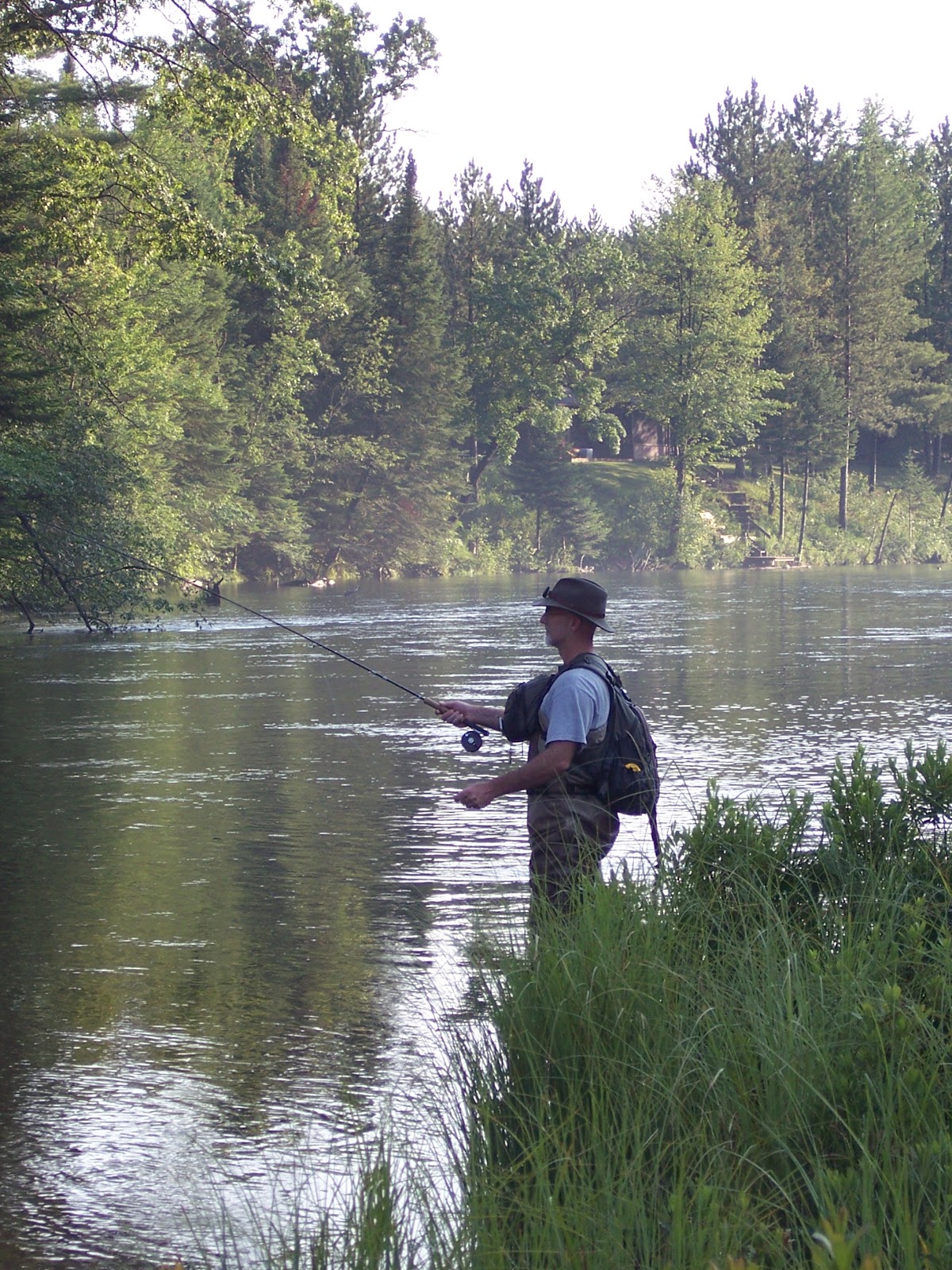
The AuSable River is a clear, cold, slow-flowing river in central Michigan. It’s not stereotypical trout territory because there are no mountains and steep, rocky rivers. The surrounding terrain is mostly low, rolling hills of sand, pines, and fir trees, so the AuSable is quiet and unassuming. And yet, it is one of America’s great trout rivers.
 
AuSable riverbank
 
For those of us accustomed to wading in the slippery-rock rivers of the Southern Appalachians, the AuSable is a welcome reprieve. Its gentle current and sandy bottom make wading easy, the only problem being an occasional patch of mud and weeds so thick they can suck the boots right off your feet, which is something I know from experience. The mud and weeds provide prime habitat for the kinds of insects that trout relish, so the trout are big and the wading is easy. . . even at night.
 
It was about 1 am, and I had been fishing since the sun set about three hours earlier. Or, to be more precise, I had been standing around hoping to hear feeding fish that I could cast my fly to. So I had been listening for several hours, without actually fishing. A lot of what passes for “fly fishing” is actually just standing around waiting for something to happen. For many generations, the most important skill for the aspiring fly fisherman has been the ability to be alone with one’s own thoughts or a good book. I suppose smart phones and iPods may change all that. Why read Thoreau when you could be playing a video game?
 
 
That’s the downside to chasing bugs, hoping that they’ll land on the water’s surface as planned, prompting the fish to jump into a full-blown feeding frenzy. The bugs usually show up so consistently that you can set your calendar and your watch by them. In late-May it’s the Sulphur Mayflies; in early June it’s the Brown and Gray Drakes; by mid-June it’s the Hexagenia Mayflies. Most of these bugs mate and die then drop to the surface of the water in the cool evening air at dusk. You can count on it.
 
How it's supposed to work: fishing at night.
 
What you can’t count on is where. You can be sure they’ll hatch, mate, and die first on the North Branch and then, about a week later, on the South.  However, this insect activity can be patchy. One of us may be standing in a spot where the bugs and fish are going crazy while another is standing 50 yards away in water that’s as lifeless as a cemetery.
 
Just Piddling, Waiting for the Big Bug Event
 My night so far had been spent in a dead zone, and now as I waded my way downstream I realized that I had waited too long. I had stayed in the dead section, expecting it to turn on at any moment, only to find out that it wouldn’t turn on at all. Once again I’d spent several hours listening and hoping, then wondering, then despairing… but never actually fishing. Once I decided to move elsewhere, the show was over. The bugs had probably arrived, the fish had eaten them, and I had missed it because I was in the wrong place at the right time, which isn’t quite good enough.
 
So, like a whipped pup, I sulked my way quietly downstream toward the rickety, old public dock where I would get out and wait for Tim and Keith to return with tales of their fishing exploits. I, once again, would have to report no bugs and no fish for the second night in a row.  I wasn’t looking forward to our reunion.
 
As I approached my take-out point at the dock I saw the light of a cigar ahead. No sound, just a tiny, orange glow. This nighttime insect activity draws fishermen from throughout the eastern US, so it’s not unusual to see a few fellow fly fishers on the river after dark. It’s common courtesy for the guy who’s wading through to ask permission to pass, at which point the guy who is stationary will tell the wader which side to wade down on. Usually the best route is along the river’s edge behind him because he’s usually standing a few feet out in the river watching for bugs and fish in the middle and across the river.
 
Hex mayflies and Purple Iris
 I said “Hello?” I didn’t have to shout because the night was deep, the river was quiet, and the sound of my voice would drift unhindered down the river.
 
A “hello” returned to me from the vicinity of the orange glow, sounding so hollow that at first I wondered if I had heard my own echo. But my “hello” had a question mark at the end of it while the response was in the declarative mode with a Midwest accent. Plus, this part of the country has very few hard surfaces to create echoes. So I continued, “Which side should I wade down on?” I guess this is about as close as a guy normally gets to asking permission. It’s not exactly a “may I wade through” kind of request. It’s more of a “I’m coming through, so just tell me where so I don’t spook the water where you’re fishing.” Of course, that’s way too many words for two guys to exchange. Thus, the abbreviated “Which side…” version.
 
An old man’s voice responded slowly and clearly from out of the darkness: “I’m not fishing.” [To be continued]
 

Saturday, September 1, 2012

Throwin' 'em Back


I don’t eat the fish I catch. I’d like to say that it comes from a deep commitment to maintaining a balance in nature or a well-thought-out wilderness ethic – you know, a “take only pictures, leave only footprints” kind of thing – but the truth is much simpler than that: I’m selfish and lazy. I throw the fish back because I’m too lazy to clean them, and if I throw them back then maybe they’ll be there the next time I fish that spot. On a slow day, it’s good to know exactly where the fish are (because you put them there), even if you can’t see any evidence of their presence. Catching a fish in a spot that gives no outward appearance of having fish makes you look like a magician or alchemist who can turn a rock into gold, or in this case, water into a trout.


Such a fisherman can soon gain the reputation of being a master of the craft, someone who has special knowledge that has been hidden for millennia from mere mortals. The Da Vinci Code had the Priory of Sion. Fly-fishing probably has its own secret society, its Sect of Enlightened Ones, who can conjure up a trout in adverse conditions. I said there’s “probably” such a secret society. I wouldn’t know for sure because I’ve not been invited to join and am certainly not a likely candidate for membership. I’m just a guy who claims to be a fly fisherman, but all that really means is that I own a few fly rods and take them out to the river every now and then.


Catching and releasing a big fish is especially hard because the male ego kicks in once a trout reaches the 18 to 20 inch range. A 20 inch trout just needs to be bragged about and shown off, like a new truck. In fact, many of the same questions apply: What kind is it? (Chevy or Ford, Rainbow or Brown.) How big is it? (Horsepower or inches.) How fast does it go? (Fast enough to scare me.) Maybe size doesn’t matter in all areas of life, but in fishing it does. It’s not the only thing, but it’s usually the main thing.


Now you might think that the regulations in a mountain wilderness like the Smoky Mountains would require catch and release, to preserve the wilderness, untouched by humans. After all, it’s illegal it pick wildflowers, ramps, ginseng; pretty much anything. But you can keep any trout over 7 inches.


I know what you are thinking: “Seven inches? Doesn’t that mean you can keep all your fish? Aren’t they all bigger than that?” Well, actually, no. Six inches is very common; seven is about average. A 12 inch trout in the Smokies is a big fish. A 12 inch brook trout would be legendary.


If you are a bass fishermen, you’re proabably giggling right now, right? Any species where 12 inches is “big” is not worth getting your feet wet. Well, under normal circumstances I might agree with you. But there’s another rule at work in the Smokies: context. Context matters.


After a day of catching 6 and 7 inch trout, the occasional 9 or 10 inch fish will make you giggle like a school girl getting ready for her first dance. A 12 inch fish will make you look around for someone to tell your story to. Of course, in such situations you are usually alone, so you have to settle for a moment of self-congratulations. You’ll talk to the fish, even thanking him the way ancient hunters would apologize to an animal’s spirit for catching and killing him, and then you gently slip him back into the water. You part as friends. And, of course, being friends, you make a note of where he lives so you can come back to visit him again.  (Maybe next year when he’s an inch or two longer.)


The other part of the “context” is the mountains, rocks, rushing water, rhododendron, and all the other stuff that brought you there. That’s when you remember why you came and spent the day wading in a river. Actually catching fish was one of the reasons, but it wasn’t the only reason. It wasn’t even the main reason. That’s why you don’t regret throwin’ em back.


Tuesday, July 10, 2012

Wet Feet, Cold Supper, and a Good Day on Raven Fork (Part 5 of 5)


For about four hours, Greg Harrell and I walked along and in Raven Fork. The water level was low, and there were many exposed, streamside boulders and gravel beds for us to walk on, but at some point it became easier to just walk in the water. Every time we off-trail hike along a river, we end up in the water. We call it going over to the dark side. I don’t know why. It just sort of happens that one of us tires of rock hopping and steps in to the water while the other tip-toes along the rocks at the edge, trying to stay dry. It’s at this point that the wet one taunts and tempts the dry one to join him. “Come on down, you sissy, the water’s fine. Everybody’s doing it. Come over to the dark side.” At that point the dry hiker knows he’s been too timid, not wanting to get his feet wet. The male ego that expands with a good taunting compels him to get wet, so he steps in.


Hiking in the river is a bit slippery, but on a hot, summer day it’s delightfully comfortable and clean. Sweaty and dirty? Just take off your pack and dunk yourself. The water can be breathtakingly cold or refreshingly brisk. Your choice. And the soggy boots and socks are but a small price to pay.


This river hike was such a pleasant, easy, off-trail experience that I felt our purpose shift as we worked our way downstream. At some point we were no longer simply on an off-trail adventure; we were now looking for good fishing spots for our next trip here. And there were plenty of them -- dozens of runs, riffles, channels, chutes, and plunges. And, best of all, lightly fished. Surely not unfished, but several miles from the nearest road.


Sure, lots of other fishermen have had the same thoughts: drive deep into the mountains, hike away from the road, fish virgin water. And some of them have pursued those thoughts all the way to the river with a fishing rod in their hand. But how many do it, how far do they walk, and how often? The answer is probably “not” – not many, not far, not often. In other words, Raven Fork is not such a secret that fishermen will get mad at me for divulging its name in print. It’s not an untouched secret, but it is remote, so we will come back. Maybe not often – after all, it’s a three hour drive to get here, then the walking begins – but regularly.


The day ended with a 3.6 mile walk on Enloe Creek and Hyatt Ridge trails back to our tents. After a day of rough, wet, off-trail hiking, an officially-maintained trail feels like an interstate. You can shift into overdrive and set the cruise control. However, the fact that almost every step of the first 3 miles of this final stretch was uphill caused my transmission to grind to a halt several times. At least we were carrying 10 pound day packs, not 40 pound backpacks. We had covered exactly 10 miles today.


That evening we ate our uncooked meals consisting of granola bars, peanut M & Ms, and a few other items that I can’t remember. One thing about going cookless is that the meals are not memorable – unless you have no fear of fat grams and sugar. Then you can eat wonderfully and recklessly – chips, cookies, nuts, candy. It’s like being let off your leash. But if you have any dietary scruples at all, then you look forward with anticipation to bedtime, but not to supper. Supper is just something you have to do.  I don’t know how the younger guys feel, but at my stage in life, that’s fine with me. Bedtime is usually the highlight of my day anyway.


As darkness settled in we heard a couple of calls from a Barred Owl asking, “Who cooks for you? Who cooks for ya’ll?” He seemed to know we were eating a cold, uncooked supper and took this opportunity to taunt us a few times before he began his nightly hunt and feast. Mice would die tonight. He would eat like a king while we slept, but I wasn’t jealous. I had my tent, sleeping pad, pillow, and memories of another good day in a wild part of God’s creation. It is well, it is well with my soul.


Thursday, June 14, 2012

The Most Beautiful Spot in the Smokies? (Part 4 of 5)

It took about two hours for Greg Harrell and me to work our way along Breakneck Ridge and down its north slope to Three Forks Pool on Raven Fork. Three Forks is a pleasant spot in the river where two small creeks converge just as they flow into the main branch. Here the terrain flattens just enough to slow the river’s flow and to provide a flat, riverside area to rest or camp. Actually, camping here is now illegal, but that doesn’t seem to have completely deterred everyone. There were several campfire rings and small piles of firewood nearby – remnants of small acts of civil disobedience. Or, just spots where some guys decided to flaunt federal law and play hide-and-seek with the rangers. It’s a nice spot, but I wouldn’t call it the most beautiful spot in the Smokies as the old National Geographic article had done.

In fact, it was here that Greg and I decided that we would start our Top 1,000 list – our list of the 1,000 “best places in the Smokies.” The point is that there is no single spot that is the best or prettiest or whatever, and anyone who claims there is needs to get out more and look around. There are hundreds or thousands of river valleys, pools, waterfalls, heath balds, grassy balds, beech gaps, meadows, cliffs, boulder dens, rhododendron thickets, hardwood forests, log cabins, rock walls, old churches, mountain top panoramas, wildflowers, and spruce forests that could all qualify as the most beautiful sights, but none are better than the others. Don’t even try to come up with a single best location. Just put them all in the top 1,000 and move on. So, is Three Forks Pool the most dramatic, impressive, beautiful spot in the Smokies? Absolutely not, because there’s no such thing, but Three Forks, like many other bends in the river, is in the top 1,000. It’s tied for first with 999 others.

But Three Forks is special because it’s so hard to get to. In fact, that is probably the secret ingredient that qualifies some sites for special recognition within the Top 1,000. Knowing that you are enjoying a spot that only a handful of people see each year is not only good for the ego (“We walked four hours to get here. How many people would do that?”), it’s also good for the soul. The stillness is somehow stiller, the wildness is wilder, and the isolation is that healthy kind of loneliness that you get when you separate yourself from the pack because you are following a different drummer, taking a path less travelled. In this case, literally a path less travelled, or no path at all. There are reasons why people use phrases like “off the beaten path” or “the road less travelled” to describe their great, solitary, life-changing experiences.

The route we took from our car at Round Bottom up and over Breakneck Ridge to Three Forks takes a total of 3 to 4 hours. However, because we started our day at McGee Springs campsite, we were less than two hours into our hike when we arrived at the river. After lounging and fishing (Greg caught 3 brook trout and one brown on a Thunderhead dry fly) for about an hour, we were ready for part two: Raven Fork. We hoped to find remnants of the old Raven Fork trail leading us downstream for about 4 miles down to the Enloe Creek trail and campsite. The fact that there had still been a light trail across Breakneck Ridge was encouraging because the river would probably be more heavily travelled.

To make a long story short, if more people travel along the banks of the river, we weren’t able to prove it. We followed a faint trail out of the old (illegal) campsite at Three Forks for 15 or 20 minutes. It then disappeared into the river, never to emerge again. No pieces of blue tape. No unnatural openings in the riverside bushes. No worn trail. No government cover-up.

Of course, there could have been a trail. On those hikes which we do find an old trail, there is usually no clue to its presence until we step on to it. It makes such a small dent in the underbrush that you can be standing three feet away without seeing it. I suppose that’s good news because you can push your way through a thicket of briers or rhody with the feeling that you are nowhere close to the old trail, only to suddenly find that you are standing on it. Although, I suspect that it’s just as common to step on and across the old trail without realizing it. Or, to bushwhack your way almost to the trail only to give up just a couple of feet shy of your destination. That may have happened to us on Raven Fork, but of course we don’t really know how close we got to the old trail that may or may not still exist.

So we walked along and in the river. [To be continued.]